
What are we? The Liturgy of 1962
The
Fraternity and the Liturgy
The
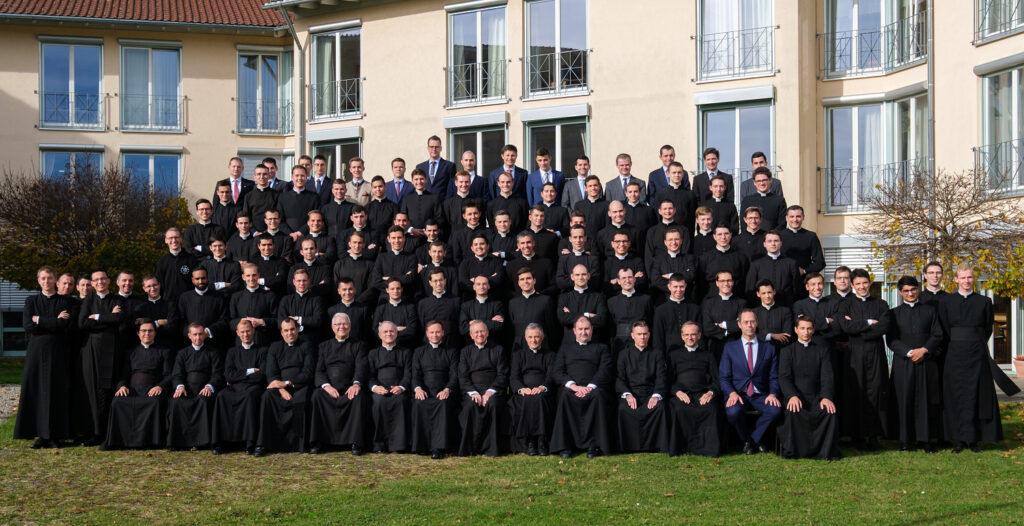
goal of the Fraternity of St. Peter is the sanctification of the
priest through the exercise of his priestly function, principally
by conforming his life to the Holy Sacrifice of the Mass by the
observance of "the liturgical and spiritual traditions"
[1] of the Church. The use
of the liturgical books in force in 1962 is granted to the members
of the Priestly Fraternity of St. Peter as well as to other priests
staying in the houses of the Fraternity or exercising their sacred
ministry in the churches of the Fraternity [2].
The use of the "traditional" Roman rite (or "tridentine"
or the "rite of St. Pius V") [3]
in the form in which it was current in the Latin Church prior to
the reform of 1969 is a specificity of the Fraternity of St. Peter.
It is therefore fitting to explain our reasons in brief for being
attached to this rite which in general is so little known.
The
Liturgy in the Church
The
entirety of the cult which the Church renders to God", wrote
Pope Pius XII in the encyclical Mediator Dei, "must needs be
at once interior and exterior. Exterior certainly, because the nature
of man, being a composition of soul and body, demands exteriority,
for Divine Providence intended us to be drawn by the knowledge of
visible realities to the love of invisible realities (…). But the
essential element of the cult is the interior element, because it
is necessary always to live in Christ, to be entirely devoted to
Him, to give glory in Him, with Him and through Him, to the Father
in Heaven [4]. Thus it is
that the "realities of the senses become the place wherein
are expressed God's work of sanctification and man's work of cult
to God" [5]. The Church,
Bride of Christ, guides the hand of Her children in the course of
liturgical prayer. The liturgy is then defined according to the
Constitution Sacrosanctum Concilium "as the exercise of the
priestly function of Jesus Christ in which the sanctification of
man is signified by perceptible signs and realized in a manner proper
to each; and in which the public cult is peformed in its totality
by the mystical Body of Jesus Christ, that is to say by the Head
and Its members [6]. In
the liturgical prayer the members of the Church are inserted in
the cult rendered by the Son to the Father. "In consequence,
every liturgical celebration, as the work of Christ the High Priest
and His Body which is the Church, is the sacred action par excellence,
to which no other action of the Church is equal in efficacity in
the same way and to the same degree" [7].
The
liturgical signs comprise both an essential sign, which is necessary
to the sacramental validity, and secondary signs, which envelop
and surround the essential sign. All these sacred gestures and words
designate a reality of Grace, mysterious and transcendent, and at
the same time make it present, efficacious, and fruitful. "The
mystery of the Mass transcends its manifold expressions in the liturgy.
However legitimate or necessary they may be they remain inadequate
by their nature. They represent truths which are only truths in
part, which are in a relationship of internal tension the one to
the other. Should one insist above all in the liturgy on the primordial
rôle of the sacrifice of Christ which encompasses all others rôles
and is sovereign in its efficacity? Or should one rather stress
the secondary rôle which is played by the sacrifice of the Church
and the participation of the faithful? (…) Should we adore in silence
the ineffable mystery of the Redemption of the world made present
in our midst? Or should we have it acclaimed by the multitude? One
sees that the tensions which have given rise to the different rites
re-appear within the one rite. To the regard of faith and contemplation,
the mystery of the Redemption continously made present in every
Mass is one, perfect, immutable, infinitely simple, embracing in
its horizon all time and space, and absolutely transcendent as to
its liturgical forms, which in themselves can only assume a secondary
importance. And yet to preserve and sustain the good order and life
of the ecclesiastical community these liturgical forms are essential"
[8].
The
Traditional Liturgy
The
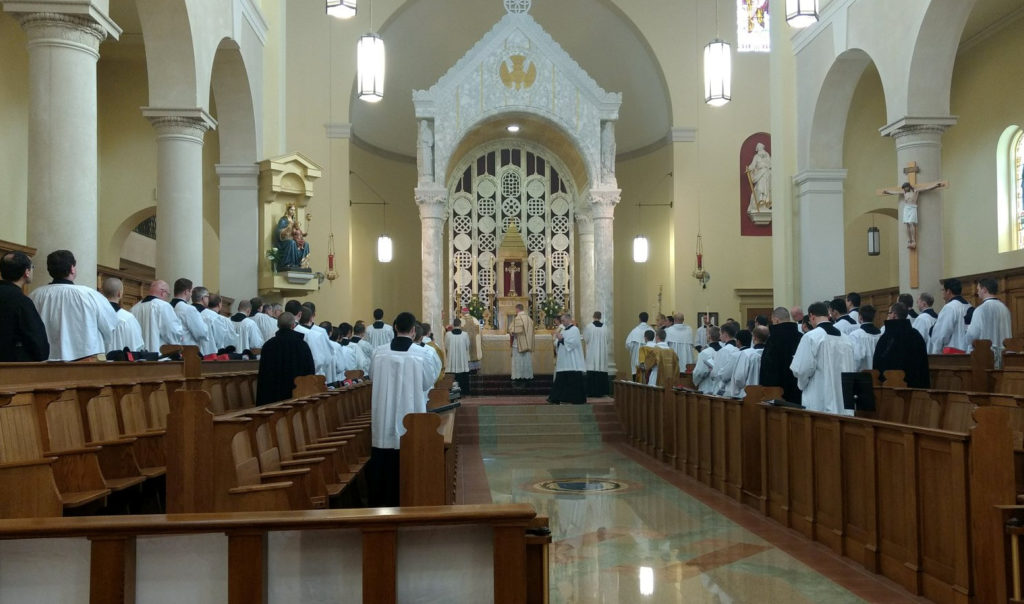
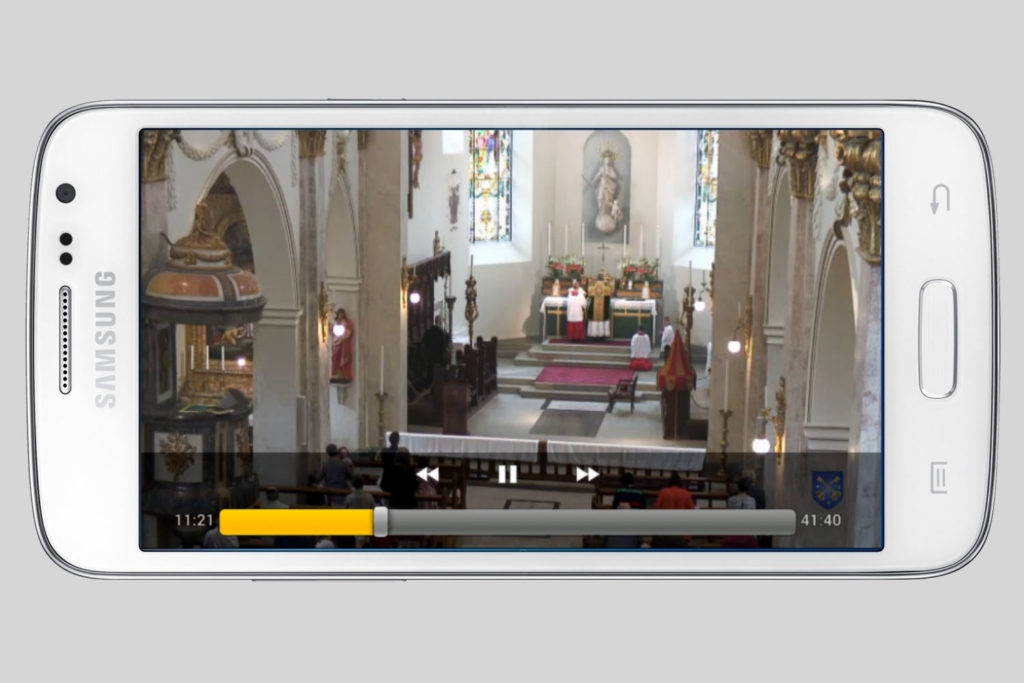
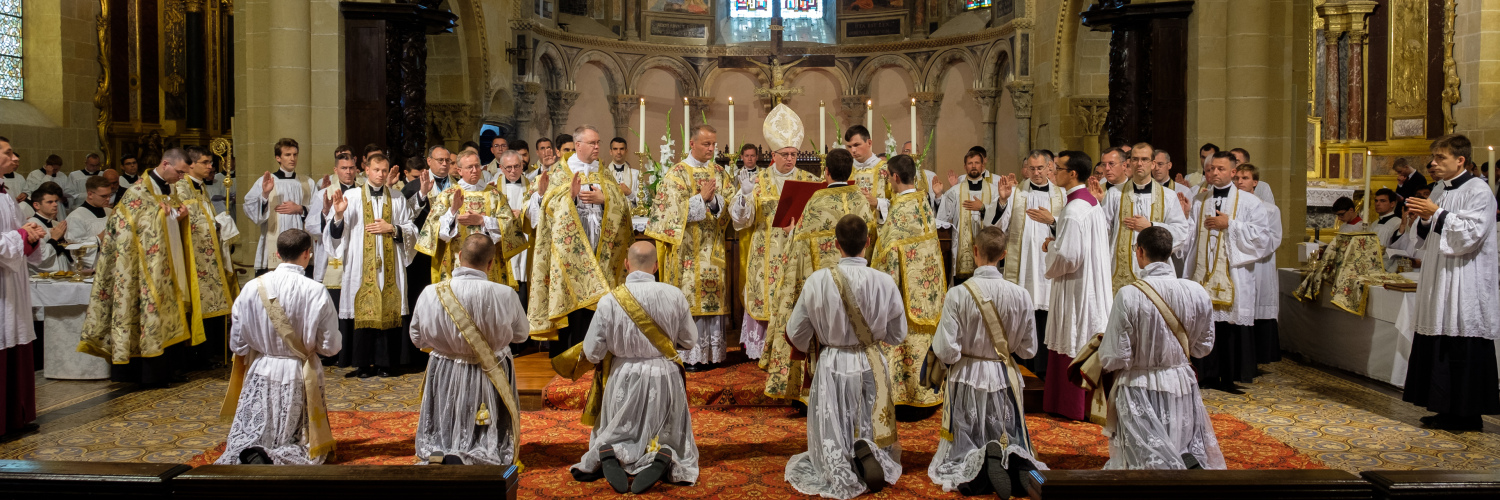
Tridentine liturgy is one of the liturgical forms of the Church.
Codified after the Council of Trent "in times of real difficulty
where the Catholic faith had been put in question as to the sacrificial
nature of the Mass, the ministerial priesthood, and the real and
enduring presence of Christ under the Eucharistic species, the primary
task of St. Pius V was to preserve a tradition which was relatively
recent [9], and had been
unjustly attacked: And this he did by introducing the least possible
changes in the sacred rite." Such is the manner in which the
context of the Tridentine reform and consequently the assets of
the Tridentine Missal are described in the Institutio Generalis
of the reformed missal (n. 7 of the preamble added in 1970). We
may well then ask to-day, as faith and piety towards the Blessed
Eucharist are diminishing, whether one way to counter contemporary
theological, spiritual, and pastoral inadequacies is not the celebration
of the Eucharistic mystery by means of the liturgical forms of the
Missal of St. Pius V.
The traditional liturgy in fact gives acute expression to the
Sacrifice of the Cross made present on the altar, orients the soul
toward God, and witnesses our adoration of His Real Presence. Clearly
the Mass should not be viewed as a theology lesson, but its prayers
express a doctrine eloquent indeed, including the four finalities
of the Holy Sacrifice: adoration, thanksgiving, propitiation, and
petition. It is only natural that the prayers of the Mass should
be oriented towards adoration, because man's first duty as creature
is to acknowledge his total dependance on God. This, then, is the
first finality of the sacrifice. Next we may observe that most of
the prayers of the 1962 missal as well as the various prayers of
the offertory and canon, are fervent petitions for God's graces,
the first being that God deign to accept the sacrifice. The prayers
of the offertory manifest clearly the propitiatory character of
the offering: Jesus Christ immolated for our sins in accomplishment
of the Redemption. All this, amongst other things, is explicitly
contained in the rich texts of the traditional offertory.
Let
us note too that the Tridentine rite, after the fashion of incense
rising towards Heaven, elevates our souls to God, and, as it draws
us from the realities of the senses to the eternal mysteries,
permits us, already on earth, to unite our voices to those of the
Blessed. This is the goal of all the gestures and of all the ceremonies.
The orientation of the altar, the gestures of adoration, the sacred
language, the mystery and the silence which surrounds the consecration:
all these aspects manifest the sacrality of the Mass. Is it
not because he is minister of the Church, as we have said above,
that the priest employs for example in the course of his sacred
ministry a language which is not his mother tongue, but rather the
language of the Church for whom he is acting as ambassador? The
language of the Tridentine rite is of course Latin [10].
Most of the prayers of the Mass date from the first centuries of
the Christian era. It is a matter of general agreement to-day that
the Canon (the central prayer of the Eucharistic Sacrifice) was
fixed almost definitively by the end of the fourth century [11]!
In 1570 Pope St. Pius V did not thus "compose" a new missal:
he simply harmonized the prayers and rites which antedated it by
a long period.
Silence is in itself the finest expression of our adoration of
the God who descends upon our altars, and most expressive of the
mystery which is enacted there. As St. Ignatius of Antioch teaches
us, silence accompanies mystery: "The Virginity of Mary, the
birth and death of the Lord are three resounding mysteries which
God worked in silence." The silence during the Canon is the
most ideal means for fostering a truly profound, personal, and interior
participation in the mystery of the altar. Music also holds a
supereminent position in the classical liturgy: Gregorian chant
and sacred polyphony have developed in the course of the centuries
in order to serve and to embellish it.
A
Heritage... to pass on
T he
liturgy of the priests of the Fraternity of St. Peter is, in a word,
a heritage, it is, as its origin shows, the expression of the piety
and sanctity of the Church. Innumerable are the saints who have
known it, and its benefits are still visible to-day: every day its
riches surprise anew those who celebrate it. It is a precious guide
for the whole length of our pilgrimage here below towards God. Pope
John Paul II in a message addressed to the plenary Assembly
of the Congregation for Divine Worship and the Discipline
of the Sacraments held in September 2001 at the Vatican, declared: "The people
need to see in the priests and deacons an attitude full of reverence
and dignity, capable of helping them penetrate invisible things,
even without a multiplication of words or explanations. In the Roman
Missal, known as the Missal of St. Pius V, as well as in the various
oriental liturgies one finds very beautiful prayers by which the
priest expresses a very deep sentiment of humility and reverence
in the presence of the Holy Mysteries: these sentiments reveal the
essence of all liturgy."
Here then in a few words - and in a very summary fashion – are
the reasons that the Fraternity of St. Peter is attached to the
classical Roman rite. We have spoken essentially of the liturgy
of the Mass, but in fact the members of the Fraternity of St. Peter
have at their disposition all the liturgical books that were in
force in 1962[12] (The Missal, Breviary, Ritual, Pontifical, and Ceremonial
of Bishops). This liturgy contains riches which the Church has entrusted
to the Fraternity as a treasure. Following the example of the good
steward of the Gospel, their desire is to defend it, to live by
it, and to hand it to future generations.
______________________
[1] Constitutions of the Fraternity of Saint Peter,
Art. 8; see also the Apostolic Letter
"Ecclesia Dei" Motu Proprio of H.H. Pope John Paul II, 2nd July 1988.
[2] Decree of Erection
of the Fraternity of St. Peter, 18th October 1988.
[3] Pope St. Pius V (1566-1572), applying
the decrees of the Council of Trient, that had desired the revision
of the liturgical books, published an editio typica of the Breviary
(1568) and of the Missal (1570). The Pope's design, faithful to
the intentions of the Council,was not to compose new liturgical
books, but to bring the prayer of the Church back into conformity
with the ancient tradition of the Fathers and to establish unity
in the celebration of the rites.
[4] Pius XII Encyclica Mediator Dei,
20th November 1947 (23).
[5] Catechism of the Catholic Church (1148).
[6] Second Vatican Council, Sacrosanctum
Concilium (7).
[7] Second Vatican Council, Sacrosanctum
Concilium (7).
[8] Cardinal Charles Journet, The Mass: Presence
of the Sacrifice of the Cross, DDB 1961 (p. 317-9).
[9] Pope Paul VI in the Constitution Missale
Romanum which precedes this text nevertheless traces its
origin back to St. Gregory the Great!
[10] "The language of the Church must be
not only universal but immutable. If in fact the Truths of the Catholic
Church were entrusted to certain or several human languages, subject,
as they are, to change, and none of them having greater authority
than any other, then such a variety would ensue that the sense of
these truths would be neither sufficiently clear nor sufficiently
precise for all." Bl. John XXIII, Veterum Sapientić,
1962.
[11] Revd. Joseph-A. Jungmann S.J., Missarum
Sollemnia, Aubier, 1951 Vol. I p. 81.
[12] Decree for the use of all liturgical books in force in 1962, 10th September 1988; see also the Decree of Erection
of the Fraternity of St. Peter, 18th October 1
|